When the Monolith Became the Enemy
Three years ago, our engineering team sat in a conference room staring at a sprawling monolith that had grown from a scrappy startup MVP into something resembling a digital Frankenstein’s monster. The application handled everything from user authentication to payment processing to inventory management, all wrapped in a single deployable unit that took forty-seven minutes to build and required a PhD in archaeology to understand the dependency graph. The decision to break it apart into microservices felt inevitable, even righteous.
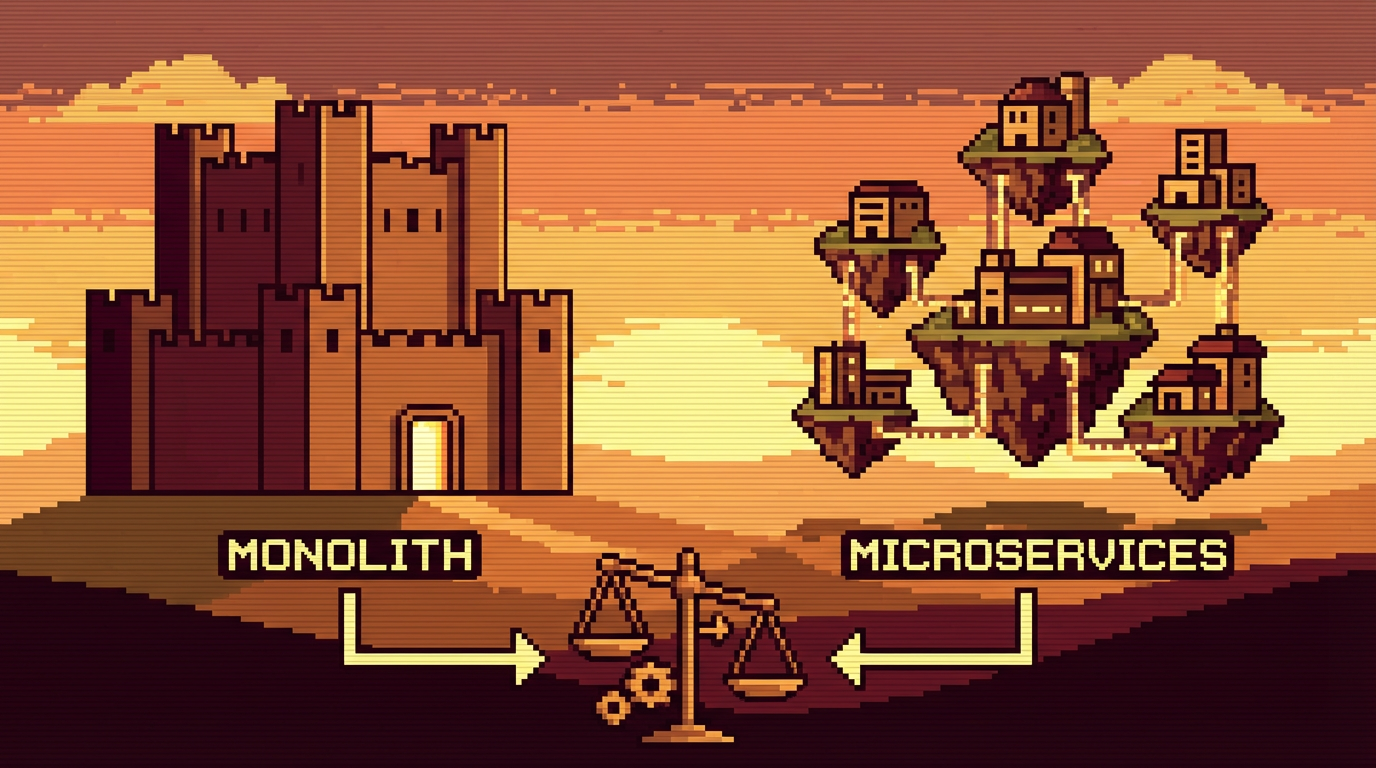
Looking back, that feeling of inevitability should have been our first red flag. We were caught up in the same evangelical fervor that sweeps through engineering teams when a new architectural pattern promises to solve all our problems. The conference talks made it sound so clean: small, focused services that could be developed, deployed, and scaled independently. Teams could move faster, technology choices could be more flexible, and surely our production incidents would become a thing of the past.
The reality, as it turns out, was much messier than the slide decks suggested.

The Migration Reality Check
The first service we extracted was user authentication, which seemed like a logical starting point. Simple domain, well-defined boundaries, and relatively few dependencies. What could go wrong? Everything, as it turned out, but in ways that were both predictable and completely unexpected.
The predictable problems were around distributed systems complexity. Network calls that used to be in-memory method invocations suddenly had latency, timeouts, and retry logic to consider. Our previously atomic operations became eventually consistent distributed transactions with all the joy that entails. Testing became an exercise in choreographing multiple services, and local development required running a constellation of dependencies that consumed more RAM than our laptops possessed.
The unexpected problems were more insidious. Our carefully crafted service boundaries turned out to be more like suggestions than actual walls. The authentication service needed user profile data for JWT claims, which meant either duplicating data or making the profile service a dependency. Both choices felt wrong, but we had to ship something. We chose duplication and told ourselves we’d fix it later, a decision that still haunts our data consistency models to this day.
Six months into the migration, we had successfully transformed one medium-sized problem into twelve smaller problems that somehow felt larger in aggregate. The team was spending more time on infrastructure and inter-service communication than on actual business logic. Our deployment pipeline had evolved into a complex orchestration of service dependencies that made the original monolith build look quaint by comparison.
The Unexpected Benefits and Genuine Trade-offs
Here’s where it gets interesting though. Around month eight, something clicked. The teams responsible for individual services started developing a deeper understanding of their domains. The authentication team became genuine experts in OAuth flows and token management. The payment team dove deep into PCI compliance and fraud detection. Specialization bred expertise in ways that the monolith had never encouraged.
More importantly, we discovered that some services genuinely needed to scale differently. Our image processing service required completely different infrastructure than our user management service. The monolith had forced us into a one-size-fits-all approach that was suboptimal for everyone. Being able to choose the right tool for each job turned out to be more valuable than we’d anticipated, even if it did mean learning Rust, Go, and keeping our existing Python services running simultaneously.
The real revelation came during our first major incident post-migration. When the payment service went down, users could still browse products, manage their profiles, and even add items to their carts. The blast radius was contained in a way that would have been impossible with the monolith. Yes, we had more moving pieces to monitor and debug, but when things went sideways, they went sideways in predictable, isolated ways.
What Actually Matters in the Decision
After living through both sides of this architectural divide, I’ve concluded that the microservices versus monolith debate often focuses on the wrong variables. The question isn’t whether microservices are inherently better or worse than monoliths. The question is whether your team and organization are equipped to handle the operational complexity that comes with distributed systems.
If you have a team of five engineers who are already struggling to maintain consistent coding standards and deployment practices, adding network boundaries and service coordination to the mix will not improve your situation. Microservices amplify both your capabilities and your dysfunction. A team that can’t manage database migrations reliably will not suddenly become competent at managing distributed transactions and eventual consistency.
The organizational factors matter more than the technical ones. Do you have dedicated devops expertise? Can your monitoring and observability stack handle distributed tracing across multiple services? Are your teams mature enough to own services end-to-end, including on-call responsibilities? These aren’t glamorous questions, but they’re the ones that determine whether your microservices migration becomes a productivity multiplier or a cautionary tale.
The Wisdom of Boring Choices
Two years post-migration, our architecture is a hybrid that would make purists on both sides uncomfortable. Some services remained as part of a smaller but still substantial monolithic core. Others were extracted successfully and operate as independent services. A few were merged back together when the service boundaries proved to be fundamentally wrong.
The most successful extractions were the ones driven by genuine operational needs rather than architectural ideology. The image processing service needed different scaling characteristics and made sense as a separate deployment. The notification service needed to integrate with multiple third-party APIs and benefited from isolation. The user profile service, despite being a seemingly obvious candidate for extraction, worked better when it remained part of the core monolith because of its tight coupling with authentication and authorization logic.
This middle path lacks the elegance of a pure microservices architecture or the simplicity of a well-designed monolith. But it reflects the messy reality of working with software systems that have real constraints and real deadlines. Sometimes the most innovative choice is the boring one that acknowledges your current capabilities rather than your aspirational ones.
The conference talks rarely mention that the most successful architectural decisions are often the ones that feel slightly disappointing at the time. They’re based on honest assessments of team capabilities, operational maturity, and business requirements rather than the latest trends or the most intellectually satisfying patterns. If you’re wrestling with this decision for your own systems, I’d love to hear about your specific constraints and trade-offs. The devil, as always, is in the details that don’t make it into the blog posts.