One Year In: Why Engineering Teams Are Botching the NIST CSF 2.0 Govern Function

The Govern Function Arrived With a Mandate Nobody Was Ready For

February 2024 feels like yesterday and five years ago simultaneously. That’s when NIST dropped Cybersecurity Framework 2.0, and with it, a sixth function that fundamentally shifted how we’re supposed to think about security architecture. If you’ve been through enough compliance cycles, you know the drill: frameworks arrive, consultants pivot their decks, security teams scramble, and then most organizations sort of half-implement whatever feels closest to their existing structure.

One Year In: Why Engineering Teams Are Botching the NIST CSF 2.0 Govern Function

Except this time feels different. The Govern function isn’t a technical control you can bolt onto your infrastructure. It’s an organizational restructuring wrapped in risk language, designed to make cybersecurity everybody’s problem, starting with the boardroom. The function explicitly targets organizational accountability structures, documented risk tolerance statements, and the cascade of decision-making that determines whether your company ships a product with known vulnerabilities or holds the line.

Here’s the problem: engineering teams hate it because it requires them to articulate things they’ve never had to articulate before. Security leadership hates it because it exposes how much of what they do has been theater. And the C-suite hates it because accountability flows upward, not sideways.

Illustration for One Year In: Why Engineering Teams Are Botching the NIST CSF 2.0 Govern Function

The 31% Problem and What It Actually Means

SANS released their 2025 survey results, and the headline was predictable enough: only 31% of organizations have fully mapped their security programs to the new Govern function. You could read that and think “okay, adoption lag, same as always.” But that’s not what’s actually happening.

The real story is that 69% of organizations either haven’t started mapping to Govern or have done it incompletely and know it. That’s not a gradual ramp-up problem. That’s a structural misalignment problem. Govern isn’t an add-on to your existing security program the way you might add a new detection layer or implement a new SIEM. It’s a prerequisite for the other five functions working coherently.

Think about this: if you don’t have documented organizational risk tolerance, how are you supposed to know whether your Identify and Protect functions are even calibrated correctly? You’re flying blind with extremely precise instruments. You know your threat landscape. You’ve mapped your assets. You’ve implemented controls. But you haven’t actually told anyone what level of risk the organization is willing to absorb. That’s Govern, and it’s the foundation everything else rests on.

The friction happens because Govern requires conversations that most engineering teams have never been forced to have with leadership. “What’s our risk appetite?” isn’t a technical question. It’s a business question that requires business leaders to make explicit choices, document them, and accept the consequences when incidents happen.

Supply Chain Risk Got Real, And the Framework Finally Caught Up

SolarWinds. XZ Utils. MOVEit. Log4Shell in countless supply chains. The original CSF from 2014 treated supply chain risk like it was someone else’s problem. It existed in the periphery, mentioned in passing, never integrated into the core decision-making structure. That gap cost companies billions.

CSF 2.0 didn’t just add supply chain considerations. It created a dedicated subcategory under Govern specifically for supply chain risk management. GV.SC lives at the governance level, which means your supply chain risk strategy has to flow from your organizational risk tolerance statement, not emerge from a security working group’s wishful thinking.

This matters because supply chain attacks don’t respect the perimeter. They don’t care about your firewall rules or your IDS signatures. They arrive through trusted relationships, wrapped in legitimacy, often with code signing certificates and everything that makes them look internal. If your governance structure doesn’t explicitly account for supply chain risk and doesn’t make it a board-level concern, you’re operating with incomplete threat modeling.

By moving supply chain risk into Govern, NIST forced organizations to make supply chain decisions at the same level where they make strategic business decisions. That’s not paranoia. That’s recognizing that your supply chain is your perimeter.

Why the Human Element Keeps Winning

Verizon’s 2025 Data Breach Investigations Report landed with its annual gravity, and one number should be hammering on your brain: 68% of breaches involved a human element. Not 40%. Not 55%. Sixty-eight percent. That’s not a security problem. That’s a governance problem.

You can’t engineer your way out of a problem that’s fundamentally about how humans make decisions under pressure, uncertainty, and competing incentives. A developer shipping code faster than is wise. An operations person clicking a link because they trust the sender. A procurement team approving a vendor without proper scrutiny because the business deadline won’t bend.

The Govern function, when implemented correctly, creates the structural conditions where these decisions get made differently. Not because people become more virtuous, but because the decision-making framework itself has changed. You’ve documented your risk tolerance. You’ve made supply chain risk a governance concern. You’ve connected cybersecurity accountability to business outcomes. Now when someone asks “can we cut corners on this implementation?” the answer has to flow through a documented framework instead of being negotiated in the hallway.

That doesn’t eliminate human error. But it shifts the probability distribution in your favor.

The Signal vs The Noise: What’s Actually Worth Your Attention Right Now

If you’re an engineering leader reading this in 2025, here’s the signal worth extracting: that 31% adoption rate for Govern isn’t staying at 31%. Regulatory bodies are starting to reference CSF 2.0 explicitly. Insurance underwriters are asking about it. Customers with government contracts are making it a compliance requirement. Adoption will accelerate.

But the acceleration will be ugly because most organizations will try to Govern-wash their existing programs. They’ll create a risk tolerance statement that says “we tolerate all risks we haven’t discovered yet” and call it done. They’ll map their supply chain inventory to GV.SC and think the work is finished. They’ll miss the entire point, which is that Govern is supposed to change how your organization makes decisions, not create another checkbox on a compliance spreadsheet.

The organizations that will have genuine security advantages in 2026 and beyond aren’t the ones that adopt CSF 2.0 fastest. They’re the ones that use the Govern function as an opportunity to restructure how their security and business decision-making interact. The ones that use documented risk tolerance as a forcing function for real conversations between engineering, security, and executive leadership. The ones that treat supply chain risk as a core input to business strategy rather than an addendum to the security program.

If your organization is still in the 69%, now is the moment. Not because compliance demands it, but because your actual vulnerability surface depends on getting this right. Start with the documentation. Make it specific. Make it real. Make it the foundation of how decisions flow through your organization.

For more detail on what Govern actually entails and how it integrates with the other five functions, the NIST Cybersecurity Framework 2.0 official documentation is surprisingly readable. And if you want to understand what the human element actually looks like in real breaches, the Verizon 2025 Data Breach Investigations Report is mandatory reading for anyone making security architecture decisions.

What’s your organization’s Govern implementation status? Are you in the 31% or still building the framework? Curious what specific friction points you’re hitting with leadership on risk tolerance documentation. Drop a note in the comments.


OpenTelemetry Is Now Table Stakes: How the OTel 1.0 Stable Spec Is Reshaping Observability Vendor Lock-in in 2026

The Inflection Point We’ve Been Waiting For

There’s a specific moment in the lifecycle of every infrastructure technology where it stops being a bet and starts being table stakes. OpenTelemetry just crossed that threshold, and if you’re not tracking what this means for your career and your organization’s architecture, you should be. The stable 1.0 specification across logs, metrics, and traces landed in 2024, and by early 2026, the CNCF reported OTel as the second most active project in its entire portfolio by contributor count. Only Kubernetes operates at higher velocity. That’s not hype. That’s gravity.

I’ve watched enough technology cycles to know the difference between genuine adoption and analyst-driven narrative. This is genuine. When a specification reaches that level of momentum, backed by every major cloud provider and a majority of observability vendors, you’re looking at an architectural inflection point. The days of waking up locked into a proprietary agent instrumentation story are genuinely numbered. And more importantly for you as an engineer or architect, the career dynamics are shifting faster than most people realize.

Vendor Lock-in Just Became a Liability, Not a Feature

Let me be direct: the observability vendor community is having a very different conversation than they were eighteen months ago. Datadog reported that 34% of their new enterprise customers were arriving with existing OpenTelemetry instrumentation already in place, during their Q3 2025 earnings call. Their CEO acknowledged this was fundamentally changing the nature of their onboarding and pricing conversations. When the category leader’s growth math is getting disrupted by customers who’ve already instrumented themselves with open standards, the game has changed.

This isn’t theoretical. It’s already reshaping how contracts are negotiated, how technical evaluations are run, and how engineers position themselves. If you’ve spent the last five years architecting around a vendor’s proprietary SDKs and agents, you’re now maintaining legacy infrastructure. That stings to hear, but it’s true. The engineers who positioned for OpenTelemetry early, or who are making that migration now, are the ones building toward the 2026 reality. The ones doubling down on closed instrumentation are increasingly exposed.

Portability Has Become the Primary Motivation, Not Cost

Honeycomb’s 2025 State of Observability report surveyed a thousand engineers about their adoption patterns. What jumped out: 58% cited vendor portability as their primary reason for moving to OpenTelemetry. Cost reduction, which used to dominate these conversations, came in at 44%. That reordering tells you something important about how engineers now think about observability architecture. It’s not about squeezing another few basis points out of your observability budget. It’s about having the optionality to walk away from a vendor without rewriting your entire instrumentation layer.

That shift in motivation is career-relevant in a concrete way. If you’re involved in observability architecture decisions, portability is now your leverage point in vendor conversations. It used to be vendor-specific features. Now it’s “will this work with OpenTelemetry?” If a vendor can’t give you a clear answer, that’s a red flag. And for your personal brand as an engineer, understanding OpenTelemetry’s architecture and deployment patterns has gone from “nice to know” to “expected competency” for anyone working on observability at scale.

The Cloud Providers Just Locked in the Standard

AWS, Google Cloud, and Azure all announced native OpenTelemetry pipeline support in their managed observability services during 2025. Let that sink in. The three providers that collectively represent the vast majority of cloud infrastructure deployment have all essentially said: “We’re making OTel a first-class citizen in our platform.” That’s not a vote of confidence. That’s a declaration that proprietary agent instrumentation is now a legacy architecture decision for new projects.

In practical terms, if you’re building new infrastructure on managed cloud observability services, you’re going to get better performance, tighter integration, and lower friction if you instrument with OpenTelemetry. The cloud providers have aligned their engineering incentives with the open standard. They’re not going to continue maintaining separate, optimized pathways for proprietary agents when they can route everything through OTel and let their customers choose what observability vendor sits on top.

The Scale Has Become Undeniable

The OpenTelemetry Collector, the open-source component that handles ingestion and processing of telemetry data, was processing over 10 billion daily spans across known public deployments by late 2025. That’s a 4x increase from 2023 figures. Check the CNCF project metrics and devstats if you want to see the real-time velocity. This isn’t small-scale adoption anymore. This is infrastructure-grade adoption. The Collector is running in enterprises large enough that their span volume would make most engineers’ eyes water.

Here’s what actually matters: the network effects have locked in. OTel is no longer the “up-and-coming standard.” It’s the standard. The observability vendors you’re evaluating are all optimizing for OTel ingestion now because their customers demand it. The SDKs and exporters are battle-tested at scale. The documentation is solid. If you want to know where to invest your time and energy in 2026, understanding OpenTelemetry architecture and deployment patterns is as foundational as understanding containerization was five years ago. The OpenTelemetry project documentation is the right place to start getting fluent.

What This Means for Your Next Move

Here’s the pragmatic take: if you’re looking at observability infrastructure decisions in 2026, the question has shifted from “Should we use OpenTelemetry?” to “How do we instrument with OpenTelemetry and maintain optionality on the backend?” That’s a healthier architecture question. It separates the instrumentation layer from the vendor layer, which is exactly where that boundary should be.

For your career, pay attention to this signal. The engineers who are actively building, deploying, and operationalizing OpenTelemetry infrastructure right now are going to be the ones with the most relevant skills when this fully matures. The vendor lock-in game that dominated observability conversations for the last decade is being fundamentally reshaped. Get ahead of that curve.

What’s your current observability architecture looking like? Are you still primarily vendor-instrumented, or have you already started the migration? If you’re at that decision point, I’d be genuinely interested in hearing what’s actually blocking your OTel adoption. The obstacles aren’t usually what people think they are.

Cursor, Windsurf, and the IDE Wars of 2025: What a Grizzled Dev Actually Thinks After Six Months

The Market Just Got Interesting (and Weirdly Confusing)

Six months ago, I would have told you the IDE landscape was basically settled. VS Code owns the volume game. JetBrains owns the professional segment. Everyone else is fighting for scraps. Then 2025 happened, and suddenly we’re watching billion-dollar rounds and strategic acquisitions that suggest the entire category might be reshuffling in real time.

Cursor raised $900 million at a $9 billion valuation in early 2025. Let that number sit for a moment. That’s not venture enthusiasm about a category—that’s institutional conviction that AI-native development tools have become central to how code gets written. The valuation alone tells you that investors believe this is not a feature layer anymore. It’s an infrastructure shift.

What makes this especially spicy: Windsurf by Codeium launched as a direct competitor using its own distribution channel, and then OpenAI acquired them for a reported $3 billion mid-year. So now we have the model provider itself playing IDE vendor. That’s not fragmentation. That’s vertical integration in real time, and it changes the entire game theory.

Performance Metrics Are Starting to Matter More Than Hype

Here’s where my grizzled skepticism actually softened a bit. For years, AI coding tools were all marketing and vibes. Now there’s actual benchmarking. The research firm Arro ran tests on multi-file refactoring tasks and found something that surprised exactly no one who understands transformers but still deserves emphasis: context window size matters more than you’d think. Models with 128K or larger context windows outperformed smaller-context competitors by 34% on their benchmark suite. Parameter count alone didn’t predict performance. It was the window that mattered.

This has direct career implications, which is why I’m mentioning it. If you’re evaluating tools based on marketing copy and model names, you’re solving the wrong problem. The real question is whether your tool can hold your entire feature branch in working memory. Can it refactor across five related files without hallucinating API calls? That’s where the daylight opened up between the pretenders and the actual contenders.

Windsurf made specific claims about its Cascade agent model producing fewer hallucinated API calls than Copilot in internal benchmarks. Cursor users reported similar gains. Whether these claims hold across your actual codebase is something you have to test yourself, but the fact that vendors are now competing on false positive rates and not just “AI writes code” is genuinely healthier for everyone involved.

Adoption Patterns Tell a Story About Generational Splits

JetBrains’ 2025 State of Developer Ecosystem report landed with some fascinating numbers. VS Code is still at 73% adoption across all developers surveyed. But when you filter for developers under 35, the picture gets complicated. Cursor and other AI-native forks had reached 13% primary use in that demographic. That’s not a rounding error. That’s a cohort vote.

The thing that won’t get headlines but should get your attention: the adoption isn’t one-for-one replacing VS Code. Lots of engineers are running dual setups or context-switching by task. Cursor for new feature development. VS Code for debugging. Cursor Editor Official Site for exploratory work, JetBrains for serious refactoring. This suggests the IDE isn’t becoming commoditized—it’s fragmenting by workflow.

Career-wise, that matters. If you’re hiring senior engineers and you assume everyone uses the same tool, you’re already behind. The next generation isn’t unified around VS Code. They’re unified around “what gets the job done fastest for this specific task.” That’s actually more sophisticated than it sounds.

The Acquisition Game Changes Everything (And Nothing)

OpenAI’s acquisition of Windsurf is the move I keep coming back to because it’s structurally different from previous consolidation in dev tools. They didn’t buy a feature. They bought direct access to the distribution layer. They own the model. They own the IDE. They own the feedback loop. That’s a closed ecosystem in ways that Cursor can’t be, because Cursor still lives in a world where the underlying model comes from someone else.

Does this mean Windsurf is now automatically better? No. Organizational integration takes time, and there are real questions about whether OpenAI’s product instincts translate to developer tools. But the structural advantage is real. They can iterate on model-IDE co-design without negotiating with another vendor. That’s a multiplier.

What this should tell you as a career engineer: the tools you choose are increasingly bound up with vendor strategy and distribution control. Pick tools that have aligned incentives with your actual workflow, not just tools that feel good in the moment. This isn’t tribalism. This is pattern recognition from someone who watched Sublime Text eat the world and then watched JavaScript frameworks do it again.

What You Actually Need to Know for 2025 and Beyond

If you’re trying to decide between these tools or figure out where to invest your learning time, here’s my honest take: context window is now the primary performance lever. The tool that can hold the most of your actual codebase in working memory will feel the fastest and produce the fewest hallucinations. Test it with a medium-complexity refactoring task across 5-10 files before committing.

Second, watch the acquisition landscape like it matters, because it does. OpenAI now has direct IDE distribution. That changes the incentive structure for how models get trained and tuned. If you’re betting on a tool long-term, know who owns it and what their distribution strategy is. Tools without sustainable unit economics or clear paths to profitability historically don’t age well.

Third, and this is the mentorship bit: don’t get caught in the tribal wars. Use what works for your team’s actual ship schedule, not what gets the most Twitter engagement. I’ve seen enough tool rotations to know that the best IDE is the one that disappears into your workflow. Right now, that’s still different for different people.

The IDE wars of 2025 aren’t over. The consolidation will be brutal and the feature velocity will be ridiculous. Your job is to stay calibrated to what actually moves the needle on your work, not what venture capitalists and model providers are positioning as the future. Stay curious about the capabilities. Stay skeptical about the claims. And absolutely test before you trust.

Platform Engineering Is Eating DevOps — And Your Org Isn’t Ready for the Reorganization That Comes With It

The Shift Nobody Planned For

Five years ago, if you told a seasoned DevOps engineer that their entire function would be reconceptualized into something called “platform engineering,” they would have nodded politely and continued optimizing Kubernetes manifests. Today, that same engineer is either retraining or quietly updating their LinkedIn. The transition from DevOps to platform engineering isn’t a terminology refresh or a rebranding exercise. It’s a fundamental inversion of how we think about infrastructure, tooling, and organizational structure.

The numbers paint a clear picture of velocity. Gartner’s 2025 analysis suggests that roughly 80% of large software engineering organizations will have established dedicated platform engineering teams by 2026, compared to just 45% in 2023. That’s not gradual adoption. That’s an inflection point. What makes this interesting isn’t the forecasting itself, but the organizational chaos hiding beneath those statistics. Most teams pursuing this shift are discovering that the hard problem isn’t the technology. It’s the people and the permission structures.

I’ve watched enough infrastructure transformations to know that when adoption curves spike this sharply, it’s usually because a new model solves a genuine problem that people have been articulating badly for years. In this case, the problem is this: traditional DevOps treated infrastructure and tooling as a supporting function that reacted to development demands. Platform engineering flips that. It treats the internal developer experience as a first-class product, with dedicated teams owning the platforms that other engineers consume.

What Platform Engineering Actually Means in Practice

Platform engineering teams own the full stack of developer experience: they design internal developer platforms (IDPs), maintain golden paths, manage deployment infrastructure, handle observability, and they do this with a product mentality. They have roadmaps. They conduct user research with their internal customers. They measure adoption metrics. They iterate based on feedback. This is conceptually tidy and organizationally devastating in ways that most leadership still doesn’t appreciate.

The DORA 2025 State of DevOps Report quantifies what this product-centric approach actually yields: teams operating with mature internal developer platforms report 2.4x higher deployment frequency and 60% lower change failure rates compared to organizations without centralized platform tooling. Those aren’t incremental improvements. A 2.4x deployment frequency means you’re shipping roughly every other day instead of every few days. A 60% reduction in change failures is the kind of metric that actually gets CFO attention because it correlates directly to revenue stability.

But here’s where the organizational friction begins: hitting those metrics requires platform teams to have genuine authority and investment. They need to make decisions about which tools get adopted, which paths get deprecated, and how development teams are guided toward best practices. They need budget that isn’t constantly raided for fire-fighting. They need to be able to say no to requests that don’t fit the platform strategy. Most organizations have never given infrastructure teams that kind of autonomy, and most developers have never had to consume a carefully designed platform instead of building their own artisanal snowflake.

The Standardization Problem That Nobody Wants to Admit

Platform engineering requires standardization. Not the soul-crushing, lowest-common-denominator kind, but thoughtful, opinionated standardization that trades some flexibility for speed and reliability. Internal developer portals like CNCF Backstage project and adoption data have become the de facto standard for surfacing this standardization in a user-friendly way. Backstage now powers over 3,200 organizations, and that adoption curve is still steep. It works because it solves a real problem: giving developers a single pane of glass for discovering services, understanding dependencies, checking deployment status, and accessing documentation without needing to know thirty different tools.

But standardization is where the political economy of organizations becomes visible. Development teams that have spent years building bespoke deployment pipelines, custom monitoring dashboards, and homegrown deployment tools suddenly need to adopt a platform-provided way of doing things. Teams that have thrived on autonomy and the freedom to choose their own tech stack now have to work within guardrails. The platform team, meanwhile, becomes the gatekeeper for that freedom. This creates friction that tooling alone cannot fix.

The 2025 job market reflects this shift. Platform engineer has become one of the five fastest-growing job titles in software, and the compensation data tells you how hard these roles are to fill: median salaries in North America hit $178,000, roughly 14% higher than traditional DevOps engineer roles. Companies are competing for platform engineers because they understand, at some level, that this role has become strategically important. What they’re often underestimating is how difficult it is to actually perform that role within most organizational structures.

Why Most Transformations Are Actually Failing

Here’s the part that separates the hype from the reality: according to Puppet’s 2025 State of DevOps Report, 67% of organizations attempting platform engineering transformations cite internal team resistance and unclear ownership boundaries as their primary failure mode. Not tooling. Not technical debt. Not cloud costs or security compliance. People and organizational design.

This deserves to be said plainly: you can have the most elegant platform, the slickest developer portal, the most sophisticated observability stack, and it will still fail if the organizational structure around it is ambiguous. When development teams don’t understand which decisions are theirs and which belong to the platform team, when platform team members have unclear reporting lines or divided loyalties, when success metrics aren’t defined or mean different things to different stakeholders, the entire system becomes friction. I’ve seen this movie twice now, and it ends with a half-abandoned platform and a demoralized team.

The organizations getting this right are making explicit choices about ownership, investment, and decision-making authority. They’re defining what “platform” actually means in their context. They’re being clear about which teams own which parts of the developer experience. They’re giving platform teams the authority to enforce standards and the resources to evolve those standards over time. They’re measuring platform adoption and quality as product metrics, not infrastructure metrics. This requires leadership alignment that most organizations simply haven’t achieved yet.

The Organizational Redesign That’s Actually Required

If you’re seriously considering a platform engineering transformation, think of it as a reorganization, not a tool upgrade. This means explicitly removing decision-making authority from some teams and granting it to others. It means redefining what “done” looks like for development teams — they’re done when their code deploys to the platform, not when they’ve configured their own deployment infrastructure. It means accepting that some of the flexibility and customization that individual teams have grown attached to will need to go away in service of platform coherence.

It also means staffing the platform team as if it’s a revenue-generating product team, because in many ways it is. The faster and more reliably other teams can ship, the faster your organization ships. The more confidence development teams have in the deployment process, the more they iterate. These aren’t nice-to-haves. They’re business drivers that should factor into budget allocation.

The transition from DevOps to platform engineering is a genuine paradigm shift in how mature organizations structure their technical operations. The numbers suggest this shift is coming, and coming fast. The tools are ready. The organizations, mostly, are not. If you’re thinking about making this move, start with organization structure and decision-making authority. The technology will follow.

Deno 2.0’s First Year in Production: Where It Delivered and Where Node.js Still Wins

The Philosophical U-Turn That Changed Everything

There’s a moment in every technology’s lifecycle when its creator has to confront a hard truth. For Deno, that moment arrived around the time Ryan Dahl realized that ideological purity, while intellectually satisfying, doesn’t pay the bills. The Deno 2.0 launch announcement in October 2024 represented something almost unthinkable: a complete reversal of the original design philosophy. The runtime that had rejected Node.js compatibility as a matter of principle suddenly embraced full npm compatibility and built-in support for the entire Node.js ecosystem.

This wasn’t a bug fix or a minor feature addition. This was Dahl essentially saying, “We were right about the problems, but wrong about the solution.” And here’s the thing that separates seasoned engineers from the perpetually outraged: that kind of pragmatic pivot is actually a sign of maturity, not failure. The team recognized that adoption in the real world matters more than winning philosophical arguments on Hacker News.

The immediate effect was significant for teams sitting on the fence. Suddenly, you could take existing Node.js code, point Deno at it, and it would work. No rewriting your entire stack. No choosing between Deno’s benefits and your production requirements. The calculation changed overnight from “Deno or Node” to “Deno and Node, with Deno handling the parts where it actually excels.”

Edge Performance: Where Deno’s Architecture Finally Matters

Here’s where the technical debt from Deno’s early decisions actually paid dividends. The runtime was built from the ground up with edge deployment in mind. That architectural decision, combined with V8 snapshot technology that pre-warms execution contexts, produces startup times that matter at scale. In synthetic benchmarks running realistic cold-boot scenarios, Deno shows consistent 20 to 40 percent improvements in latency compared to Node.js equivalents.

For context: Platformatic’s 2025 Node.js ecosystem survey found that startup and cold-boot latency was the top performance concern among teams deploying to edge environments. This wasn’t a theoretical problem or a micro-optimization obsession. This was the loudest complaint from production teams running serverless workloads. Deno Deploy, the team’s edge runtime platform, reported handling over 300 billion requests monthly by late 2025, putting it in direct competition with Cloudflare Workers. That volume isn’t a vanity metric. That’s proof that something is working.

The architecture advantage shows most clearly in environments where you’re spinning up thousands of isolates per second. The gap between a 2-millisecond cold start and a 5-millisecond cold start looks academic until you’re billing for it or watching your p99 latency spike. Deno’s snapshot approach changes the economics of edge computing enough that it becomes a genuine factor in platform selection decisions.

The Package Ecosystem Question: Growing, But Still Uneven

One of Deno’s longest-standing vulnerabilities was the package ecosystem. Node’s npm had a decade-plus head start and millions of packages. Deno had… fewer. The team built JSR package registry as their answer to this problem, with a twist: it enforces TypeScript-first publishing and generates documentation automatically. No more scanning through hastily written readme files or guessing what a function expects.

The growth numbers are hard to ignore. From roughly 2,000 packages at launch in 2024, JSR surpassed 8,000 published packages by early 2026. That’s the kind of acceleration that suggests genuine adoption, not just enthusiast tinkering. For common patterns like HTTP frameworks, database clients, and CLI utilities, you can now find well-maintained options in JSR without compromising on quality or features.

But here’s the uncomfortable truth: for specialized or niche packages, npm still wins by default. You need an obscure integration with a SaaS platform from 2015 that’s barely maintained? npm probably has three competing packages for it. JSR might have zero. This isn’t a dealbreaker for most applications, especially now that Deno can consume npm packages directly. It just means the ecosystem advantage isn’t yet decisive.

TypeScript: The Turning Point That Wasn’t

One of Deno’s most compelling advantages heading into 2024 was native TypeScript support. You wrote in TypeScript. It ran. No build step. No mysterious configuration file with 47 options you didn’t understand. Node.js developers spent years managing ts-node, tsx, or complex webpack configurations to achieve something Deno made automatic.

Node.js listened. In 2025, Node.js 23 and 24 shipped with native TypeScript type-stripping, closing a gap that had been cited repeatedly as a primary reason teams were evaluating Deno. It’s not quite identical to Deno’s approach, but it eliminates the most painful part of the TypeScript story for Node developers. The advantage didn’t disappear, but it contracted enough that the “TypeScript native” selling point lost some of its persuasive power.

This is worth examining because it’s instructive about how technology leadership actually works. Deno didn’t have to ship a perfect feature. It just had to be different and better enough that competing runtimes felt pressure to respond. And they did. That competitive pressure benefited the entire ecosystem, including Node developers who never intended to use Deno.

Where the Tradeoffs Become Clear

After twelve months of production deployments and real-world engineering, the picture has become genuinely complicated. Deno excels in specific circumstances: edge computing, fresh serverless deployments, greenfield projects where you’re not inheriting twelve years of npm decisions. Node.js remains the default choice for established applications, mature frameworks with extensive third-party integrations, and teams that have already made substantial investments in the ecosystem.

The honest assessment is that Deno’s first year in production proved something important: it’s viable. It’s not a side project anymore. It’s not a sandbox where idealists explore how things could be different. It’s a runtime that can handle serious workloads, particularly at the edge. Whether it becomes the dominant platform depends on factors outside technology: community momentum, corporate backing, and whether the marginal benefits actually move the needle for most teams most of the time.

If you’re making infrastructure decisions today, neither runtime is obviously wrong. The question is which tradeoffs align with your constraints. I’d be genuinely interested to hear about your own experience with either platform in production. What actually mattered? What turned out to be irrelevant? The patterns in those answers are more valuable than any benchmark chart.

GitHub Copilot Agent Mode in 2025: The Productivity Paradox That’s Rewriting Code Review

The Speed Trap We All Saw Coming

Let me cut to the chase because we both know why you’re here. GitHub Copilot Agent Mode hit the market sometime around mid-2025, and by the time Q3 earnings rolled around, Microsoft was announcing that the platform had crossed 1.8 million paid subscribers. That number should make you sit up straight. Not because it’s objectively huge (it is), but because it represents something we’ve been circling around for three years now: we’ve collectively decided that velocity matters more than we initially admitted.

GitHub Copilot Agent Mode in 2025: The Productivity Paradox That's Rewriting Code Review
GitHub Copilot Agent Mode in 2025: The Productivity Paradox That’s Rewriting Code Review

Here’s where it gets interesting. GitHub’s own telemetry showed that teams using Copilot Agent Mode were merging pull requests approximately 55% faster than their peers. That’s not a marginal improvement. That’s not “oh, nice, we saved a few minutes.” That’s a fundamental reshaping of how fast code gets into production. Fifty-five percent faster. Say that out loud and think about what your sprint velocity would look like if you could hit that delta on day one.

The problem, and I want to be direct here, is that speed has always been the seductive metric. It impresses executives, pleases customers, and makes you feel like you’re finally executing at the level you’ve always believed you could. When agent mode started delivering that at scale, adoption became nearly inevitable. The market chose velocity. We’re still living with that choice.

Illustration for GitHub Copilot Agent Mode in 2025: The Productivity Paradox That's Rewriting Code Review
Illustration for GitHub Copilot Agent Mode in 2025: The Productivity Paradox That’s Rewriting Code Review

The Security Reckoning Nobody Wanted to See

Now let me tell you about the part that keeps me up at night, though honestly, not in the way you might think. Snyk’s security analysis of repositories that adopted agentic coding tools in 2025 documented a 40% increase in AI-generated vulnerable code patterns. That’s material. That’s the kind of number that gets flagged in risk reviews and makes CISO offices nervous. But what actually bothers me: we’re not even sure if that’s the floor, or if we’re still in the discovery phase of how bad this could get.

Google’s Project Zero team dropped a genuinely unsettling report in November 2025 that identified 14 novel vulnerability classes attributed specifically to agentic AI coding patterns. Fourteen. Not “variations on existing CVEs” or “well-understood risks in new packaging.” These are vulnerability archetypes that didn’t have names before 2025 because the attack surface didn’t exist. Agent mode doesn’t just generate code faster. It generates new categories of exploitable code. That distinction matters enormously.

The vulnerability pattern I see most often is what I call the “confidence hollow.” Agent mode produces syntactically correct code that passes unit tests and static analysis, but it misses the distributed systems failure mode because it was trained on patterns from monolithic architectures. It generates authentication checks that look secure but have race conditions in concurrent scenarios. It writes race-condition-free code in single-threaded contexts, then gets deployed at scale where it becomes a dagger pointed at your infrastructure. The agent saw the pattern, executed it flawlessly, and nobody caught the category error until it mattered.

The Review Ecosystem Is Fracturing

Code review in 2025 is becoming a two-tier system, and we need to talk about what that means. Stack Overflow’s 2025 Developer Survey found that 82% of professional developers were actively using AI coding tools, up from 62% just the year before. That’s not adoption anymore. That’s market saturation. But here’s the part that reveals the real problem: 44% of those developers said they trusted the output only “sometimes” or “rarely.”

Sit with that number for a second. Nearly half the people using these tools don’t trust them. They’re not using them because they believe in the output. They’re using them because they have to keep pace with teams that are. That’s not technology adoption. That’s competitive duress masquerading as innovation. And it’s rewriting what code review actually looks like in practice.

Senior engineers at companies shipping with agent mode are now spending review cycles trying to validate whether the agent understood the problem correctly, whether it caught the edge cases, whether it made implicit architectural assumptions that don’t hold in your specific deployment model. That’s not code review. That’s code archaeology. You’re not reviewing for style or best practices anymore. You’re reverse-engineering the reasoning of a system that doesn’t leave breadcrumbs. The cognitive load has shifted, and most organizations haven’t equipped their review processes to handle it.

The Regulatory Response Is Real and It’s Too Late

NIST updated the Secure Software Development Framework in late 2025 to explicitly address AI-assisted code generation risks. Let me translate what that means. NIST doesn’t typically move fast. NIST is the organization that shows up to the party after it’s already a week old, documents what happened, and publishes a 200-page framework about preventing it next time. When NIST moves, it’s because something has already broken badly enough that the federal government noticed.

That update isn’t a vote of confidence in agentic tooling. It’s an acknowledgment that we shipped something into production that we don’t fully understand, and now we need guardrails because the industry won’t self-regulate. You can read the specifics in the NIST Secure Software Development Framework, but the subtext is clear: organizations using AI code generation are now operating in a compliance gray zone, and the government is setting boundaries retroactively.

Here’s what that looks like in practice. If you’re shipping code using agent mode into any regulated vertical (healthcare, finance, defense, critical infrastructure), you’re now supposed to maintain additional audit trails specifically documenting the AI’s role in code generation. You need to demonstrate that humans reviewed it according to these new standards. And if something goes wrong and it traces back to an agent-generated pattern, you’re not just liable for the bug. You’re liable for potentially negligent deployment of an insufficiently validated tool. The liability model just changed, and most organizations haven’t noticed yet.

Where We Actually Stand and What You Should Be Thinking About

Here’s my honest assessment after watching this unfold for the better part of 2025: GitHub Copilot Agent Mode is genuinely useful, and it’s also genuinely dangerous, and both of those things are true at the same time. The productivity gains are real. I’ve seen teams use it effectively, and when it works, it’s almost like having a junior engineer who never needs sleep, always knows where to find the documentation, and has read every Stack Overflow answer ever written. That’s valuable. Undeniably valuable.

But the security implications are also real, and we’re still in the phase where we’re discovering new categories of failure rather than mastering existing ones. The vulnerability classes that Google Project Zero documented are essentially the first wave. We haven’t seen the sophisticated exploitation patterns yet. We haven’t seen what happens when adversaries start training their own models to generate code that looks secure but has deliberately hidden weaknesses. That’s coming, and it’s going to make 2025 look quaint.

If you’re using agent mode right now, the responsible move is to treat it as a tool that enhances velocity in non-critical paths while maintaining human-first review for anything touching authentication, authorization, data integrity, or cross-boundary communication. That’s not sexy. It won’t max out your sprint velocity. But it won’t get you featured in a postmortem titled “How We Shipped a Vulnerability Class That Didn’t Have a Name.”

The real question for 2025 and beyond isn’t whether agent mode is good or bad. It’s whether we can build review practices and organizational cultures that maintain skepticism while capturing the productivity benefits. That’s harder than choosing a side. It requires discipline. But it’s the only move that doesn’t end with you explaining to your board why a pattern that looked secure wasn’t. Read through the GitHub Copilot Agent Mode documentation with your team and ask hard questions about where you’re deploying it. Your future self will appreciate the rigor.

I’m curious what you’re seeing in your own systems. Have you deployed agent mode? What’s your review process actually catching that you didn’t expect to have to catch? Drop it in the comments or reach out directly. The collective intelligence on this is still being written.

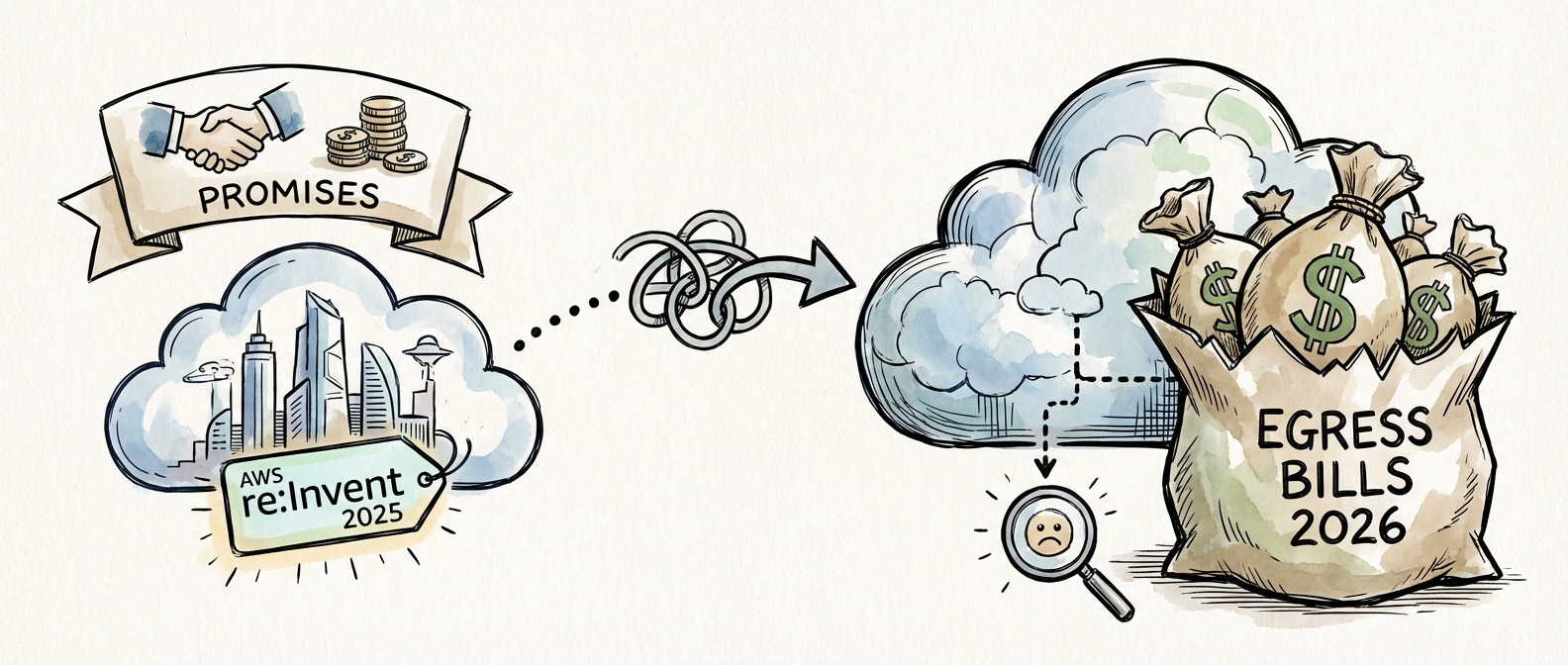
The Real Cost of Multi-Cloud in 2026: AWS re:Invent 2025 Promises vs. Actual Egress Bills

The Theater of Competitive Pricing

Every November, the cloud vendor circus rolls into Las Vegas, and this year was no different. AWS re:Invent 2025 delivered the expected announcements: further S3 price reductions, expanded zero-egress partnerships with select CDN providers, the whole performance designed to signal that Amazon heard the complaints about vendor lock-in and runaway data transfer costs. Google showed up with their Cross-Cloud Network, positioning it as the answer to multi-cloud complexity. Azure quietly did Azure things. And somewhere in a conference room, a procurement team got excited about a slide deck.

The Real Cost of Multi-Cloud in 2026: AWS re:Invent 2025 Promises vs. Actual Egress Bills

Here’s what I want you to understand before you start updating your spreadsheets: vendor announcements about pricing are theater. Effective theater, sure, but theater nonetheless. The reductions are real. The partnerships are real. But they solve a very specific problem for a very specific subset of customers, and they do not solve the problem most of us actually face.

Illustration for The Real Cost of Multi-Cloud in 2026: AWS re:Invent 2025 Promises vs. Actual Egress Bills

What the Bandwidth Alliance Actually Covers (And What It Doesn’t)

Let me be direct about Cloudflare’s 2025 Bandwidth Alliance data because I’ve spent enough hours staring at egress charges to have opinions. Enterprises moving data between major cloud providers outside of these formal agreements are still looking at $0.08 to $0.09 per gigabyte for high-volume transfers. That doesn’t sound like much until you do the math on your actual workloads. A modest 100 TB month-long replication operation? That’s between $8,000 and $9,000. Suddenly the Terraform code you wrote to be “cloud-agnostic” starts looking real expensive.

The zero-egress agreements that AWS and Google announced do exist and do work, but here’s the catch: they require you to be using specific CDN partners with specific architectural patterns in specific regions. It’s not zero-egress in general. It’s zero-egress if you conform to what they’ve decided is acceptable. For some teams, that’s a perfect fit. For the rest of us running hybrid workloads across regions and providers, it’s like being told the free parking is available if you’re willing to park exactly where they say.

The Governance Gap That Keeps Engineers Awake

Here’s where things get uncomfortable, and I’m going to say this as someone who genuinely respects both cloud architects and finance teams even when they drive each other to drink: the tools don’t exist yet to actually manage multi-cloud costs with any real sophistication. According to the Flexera 2026 State of the Cloud Report, 89% of enterprises claim to have a multi-cloud strategy. That same report also found that only 28% have mature cost governance tools in place across all their providers. That’s not a typo. That’s an eight-to-one gap between ambition and capability.

Gartner’s 2025 Cloud Cost Optimization report landed a number that should make any CTO’s eyes water: 35% of enterprise cloud spend is being wasted. The egress fees aren’t even the biggest culprit anymore. Multi-cloud networking costs are growing as a share of that waste, but they’re competing with overprovisioned instances, orphaned storage, unused reserved capacity, and the thousand small mistakes that compound across multiple providers with multiple billing systems and multiple rate cards.

The cost governance tools you’re looking at right now probably work beautifully for single-cloud environments, or for giving you dashboards that make you feel informed while you’re actually just getting very good at reading fiction. Real multi-cloud cost tracking requires visibility into inter-cloud networking, requires understanding the actual data flows in your architecture, requires knowing what you’re optimizing for. Most organizations don’t have that visibility. They have billing alerts.

Google’s Cross-Cloud Network and the Maturity Illusion

Google Cloud’s Cross-Cloud Network announced at Google Cloud Next 2025 deserves a separate moment because it represents both genuine progress and the exact kind of vendor limitation that keeps multi-cloud from actually working. The product is architecturally sound. The promise of simplified inter-cloud connectivity is real. But it comes with a critical constraint: workloads have to run on supported regions. In practice, this means you’re trading one form of lock-in for another. You’re no longer locked into a single cloud provider, but you are now locked into specific geographic deployment patterns that Google has decided to support.

This is what happens when vendors get serious about multi-cloud adoption: they solve the problem in a way that benefits their own position. Google gets to host your control plane. Google gets to see your traffic patterns. Google builds the network backbone you depend on. It’s not sinister, but it’s also not the vendor-agnostic nirvana that the marketing copy suggests.

What This Means for Your 2026 Planning

If you’re sitting in a planning meeting right now trying to decide whether to standardize on one cloud or to embrace the multi-cloud future, here’s what I’d tell you: the technology for multi-cloud is getting better, but the economics are getting worse for most organizations. The vendors have gotten smarter about competing without actually competing on the things that matter most to you.

Your data transfer costs aren’t going away. Your governance gaps aren’t going away. The complexity of managing workloads across three different billing systems, three different networking models, and three different optimization strategies isn’t being solved by better pricing for certain edge cases. You want to know what actually helps? Rigorous architecture review. Understanding your data flows before you commit to a topology. Building cost observability into your deployment pipeline the same way you’ve already built security. Choosing your multi-cloud approach based on workload requirements, not based on conference announcements.

The AWS pricing reductions are real wins for the companies that can use them. Google’s network improvements are genuine technical progress. But they’re not solving the fundamental problem: most enterprises haven’t developed the organizational capability to actually manage multi-cloud well. They’ve developed the organizational will to try it. There’s a meaningful difference.

I’m curious what you’re seeing in your own environments. Are the vendor pricing moves actually shifting your decision-making, or are you finding that the hidden costs of multi-cloud coordination are bigger than the sticker price differences? Have you found cost governance tools that actually work across multiple providers, or are you rolling your own? The real intelligence here isn’t in the vendor announcements. It’s in what you’ve learned about your own infrastructure through trial and error. Drop those insights in the comments if you’re willing to share.

The Real Cost of Multi-Cloud in 2026: AWS re:Invent 2025 Promises vs. Actual Egress Bills

The Pricing Theater We All Fell For

I sat in the keynote hall at AWS re:Invent 2025 watching Andy Jassy announce another round of S3 price cuts, and I felt that familiar feeling: the one you get when you know the headline is technically true but fundamentally incomplete. Yes, Amazon reduced storage pricing again. Yes, they signed new zero-egress agreements with select CDN partners. The competitive pressure from Google Cloud and Azure is real, and these moves prove it. But I’ve been here before. I’ve watched the pricing charts get better while my quarterly bills kept climbing, and I know exactly why.

The trap isn’t in the math on the slide deck. It’s in what happens at 2 AM when your workload in us-east-1 needs to shuffle data to your Kubernetes cluster in eu-west-1, or worse, to a workload running on Google Cloud because the business unit made a separate commitment last fiscal year. That’s when storage pricing becomes almost decorative. That’s when egress fees become the actual story.

The Egress Tax Nobody’s Talking About

Cloudflare’s 2025 Bandwidth Alliance research tells a sobering story. Enterprises moving between major cloud providers still face average egress charges of $0.08 to $0.09 per gigabyte for high-volume transfers that fall outside alliance agreements. Let me put that in real terms. If your team is running a daily backup process that moves 500 GB between AWS and Google Cloud, that’s $40 to $45 per day just in transfer costs. Multiply that across a year, across multiple data centers, across multiple business units that don’t talk to each other, and you’ve discovered where $0.08 per gigabyte turns into genuinely painful money.

I looked at our own transfer logs last quarter and did the calculation that made me stare at my screen for too long. We were paying more in egress fees than we were paying for the storage itself. Let that sink in. The commodity, the actual bytes, was cheaper than the privilege of moving them across the internet. And we had what we thought was a decent optimization strategy. We just didn’t have visibility into the full picture until we actually looked.

The asymmetry is what kills you. Moving data into AWS? Basically free. Moving it out? That’s where Amazon captures the margin. Google and Microsoft follow the same playbook. It’s not malicious. It’s just business, architected in a way that makes leaving expensive.

The Governance Gap That Costs Everything

According to the Flexera 2026 State of the Cloud Report, 89 percent of enterprises now have a multi-cloud strategy. That’s not surprising. What is surprising, in a way that keeps me up at night, is that only 28 percent report having mature cost governance tools that work across all their providers. Eight out of ten companies are playing multi-cloud chess while simultaneously flying blind. They’re making architectural decisions, spinning up resources, and committing to data transfers without a unified framework for understanding the cost implications.

Gartner’s 2025 Cloud Cost Optimization report put a number on the damage: 35 percent of enterprise cloud spend is wasted. And here’s the part that stings: multi-cloud networking costs are growing as a share of that waste. We’re not just throwing money away on idle instances anymore. We’re throwing it away on the architecture itself, on the complexity tax that multi-cloud introduces.

The problem compounds because each cloud provider gives you tools to optimize costs within their walled garden. AWS has Compute Optimizer. Google Cloud has Active Assist. Azure has Advisor. None of them can see across the fence. None of them can tell you that your multi-cloud strategy is fundamentally misaligned with your workload patterns. You have to do that work yourself, and it’s brutal work.

The New Connectivity Solutions That Mostly Don’t Help

At Google Cloud Next 2025, Google announced Cross-Cloud Network as the solution to inter-cloud complexity. Simplified connectivity. Lower latency. Unified management. It sounds elegant, and the engineering is genuinely impressive. There’s just one catch: it only works for workloads running on supported regions, and not all of your workloads are going to fit into that constraint. The promise is real. The practical adoption is limited. I’ve seen this pattern enough times to recognize it now.

This is where the rubber meets the road. The cloud providers are offering solutions to the multi-cloud problem they created in the first place. The irony would be funny if it wasn’t so expensive. You can reduce your egress costs by consolidating onto a single provider’s recommended architecture. You can avoid the complexity tax by not having a multi-cloud strategy. But the business made the strategic decision to work with multiple clouds, so here you are, paying for the privilege of that flexibility.

What Actually Works

After years of watching these cycles, I’ve learned that the solution isn’t technical elegance. It’s brutal honesty about your architecture. You need to understand your data gravity. You need to know which workloads are truly tied to specific cloud providers and which ones are just living there out of inertia. You need cost visibility that works across clouds, not just within them.

When you look at the AWS data transfer pricing breakdown, you start to see the levers. Region-to-region transfers have different costs than inter-cloud transfers. Inbound is cheaper than outbound. There are small incentives buried in the pricing structure that point toward the architecture they’d prefer you to build. Understanding those incentives is half the battle.

The other half is accepting that multi-cloud optimization requires you to be smarter than the sum of the tools the providers give you. Consolidate what matters, be ruthless about what doesn’t, and accept that real flexibility across clouds costs money. Real money. The kind that shows up on the invoice.

I’m curious what your organization has learned from this. If you’ve managed to build effective cost governance across multiple clouds, or if you’ve hit the same wall I have, I’d like to hear about it.

The Platformization Trap: Why CrowdStrike’s 2025 Threat Report Should Make Every Mid-Size Engineering Team Rethink Their Security Stack

The 62-Minute Problem Nobody Wants to Admit They Have

Let’s start with the uncomfortable number that should be keeping your security team awake at night. The CrowdStrike 2025 Global Threat Report documents something genuinely alarming: adversaries are going from initial access to lateral movement in an average of 62 minutes. That’s down from 84 minutes just one year prior. We’re talking about a 26% compression in the window where defenders actually have time to detect, respond, and contain a breach. In practical terms, that means your incident response playbook probably isn’t fast enough anymore. Full stop.

The Platformization Trap: Why CrowdStrike's 2025 Threat Report Should Make Every Mid-Size Engineering Team Rethink Their Security Stack
The Platformization Trap: Why CrowdStrike’s 2025 Threat Report Should Make Every Mid-Size Engineering Team Rethink Their Security Stack

What makes this worse isn’t just the speed. It’s the directness. These aren’t fumbling attackers doing reconnaissance. Modern adversaries are moving with purpose, which tells us they’ve either compromised your environment before, they’ve done their homework on your specific infrastructure, or both. The breakout time metric is telling you something important: detection latency is now your biggest liability. If your security tools can’t see anomalous behavior within 30-40 minutes, you’re essentially operating blind. The intruder will already be three network hops ahead, establishing persistence, exfiltrating data, or pivoting to high-value targets while your SOC is still pulling their morning coffee.

The China-Nexus Cloud Explosion Nobody’s Really Talking About

Here’s where the threat landscape gets genuinely interesting. The CrowdStrike report flagged a 150% year-over-year increase in adversary activity from China-nexus groups, with a specific and deliberate focus on cloud environments. But the really actionable detail is the targeting pattern: these actors are hunting compromised CI/CD pipeline credentials like vultures circling a carcass. If you’re a mid-size engineering team running builds through GitHub Actions, GitLab CI, or Jenkins without hardened credential management, this one’s personal.

Why CI/CD pipelines? Because they’re the skeleton key to your entire infrastructure. A compromised pipeline credential doesn’t just give you access to one system. It gives you a trusted position inside your build and deployment chain. From there, you can inject malicious code into artifacts, poison container images, or stage infrastructure changes that look completely legitimate because they came through the normal deployment process. The signal here is unmistakable: if you’re not treating your pipeline credentials with the same rigor as production database passwords, you have a fundamental security gap. And the bad actors know it.

The Platformization Trap and Why Consolidation Feels Good But Hurts Later

Now let’s talk about the architectural decision that’s currently reshaping enterprise security spending, and why it should concern you even if your organization is only moderately sized. Gartner’s latest Magic Quadrant data shows that 58% of enterprise security buyers are now pursuing platform consolidation strategies, bundling endpoint detection and response, cloud security posture management, and identity threat detection under a single vendor. That’s nearly double the 31% adoption rate from just three years ago. The appeal is obvious: fewer vendors means fewer contracts, less integration glue code, simpler compliance audits, and a single pane of glass for your security team. It feels elegant.

Here’s the problem with elegance in security architecture: elegance and resilience usually sit at opposite ends of the same axis. When everything flows through one vendor, everything depends on one vendor. You get efficiency at the cost of brittleness. The July 2024 CrowdStrike Falcon sensor update incident proved this thesis at scale. An automated update to a kernel-level security component broke 8.5 million Windows devices globally. Not because the vendor was malicious, not because the code was intentionally harmful, but because when you give a single vendor that much responsibility at that level of the stack, mistakes become catastrophic events measured in hours of downtime across entire industries.

The wake-up call here is subtle but real. Consolidation creates operational simplicity in good times and amplifies fragility in bad times. Your incident response capability is only as strong as your ability to isolate and contain compromised components. If your endpoint detection, cloud visibility, and identity protection are all managed by the same vendor through the same platform, you don’t have containment options when that platform fails. You have a binary choice: accept the outage or make emergency decisions under pressure without proper testing.

Vulnerability Disclosure at 48-Hour Exploitation Speeds

The vulnerability landscape has shifted in a way most organizations haven’t actually operationalized. The CISA Known Exploited Vulnerabilities Catalog now contains over 1,200 entries, and here’s the statistic that should change how you think about patch management: 40% of those vulnerabilities are being actively exploited within 48 hours of public disclosure. Forty percent. That’s not a tail event. That’s the new normal.

What this means operationally is that your patch SLA framework, if it’s still measured in weeks or even days, is now a measurable security liability. You can’t patch everything instantly. Your production systems need stability. But you need to make ruthless decisions about what gets prioritized, and those decisions need to happen in hours, not days. This requires a different kind of visibility entirely. You need to know, within minutes of a CVE disclosure, whether that vulnerability affects your specific tech stack, whether you have exploitable exposure, and what your blast radius would be if an adversary weaponizes it. Most organizations don’t have that level of operational clarity about their own infrastructure. That’s not a judgment. It’s an observation about the gap between current practice and current threat velocity.

What This Means for Your Next Architecture Decision

The pattern connecting these data points is clear: the threat landscape is compressing timelines everywhere. Initial access to lateral movement in 62 minutes. Vulnerabilities exploited in 48 hours. Platform dependencies creating single points of catastrophic failure. The old model of layered, slowly-updated security perimeters is officially inadequate.

For mid-size engineering teams, this creates a specific mandate. Think about your security architecture not as a collection of tools but as a system designed for rapid observability and containment. That might mean accepting some vendor fragmentation as a resilience feature rather than a procurement headache. It probably means investing in better internal logging and correlation capabilities so you’re not completely dependent on any single platform’s analysis layer. It definitely means running regular game days to practice what happens when a major security component fails, not as a compliance checkbox but as a core operational skill.

The most important decision you can make is to reject the narrative that more consolidation equals better security. The data suggests the opposite. Better security comes from understanding your dependencies clearly enough to operate without them if necessary. That’s harder to sell to budget committees. It also works better when the pressure is on. I’m genuinely curious how teams are threading this needle in their own environments. If you’ve dealt with platform consolidation decisions or redesigned around single-vendor risk recently, I’d love to hear how those conversations actually played out.

The 1,200-Vulnerability Milestone We’re All Pretending Isn’t a Crisis

When Patch Management Became a Numbers Game You’re Losing

Late 2025 hit a milestone that should have been a clarion call in security circles instead of a quiet statistic. The CISA Known Exploited Vulnerabilities Catalog surpassed 1,200 entries. That’s not a number you can dismiss as “manageable” or “under control.” It’s the moment where your patch management process—the one you’ve probably been nursing along with duct tape and automated email alerts—stops being a scalability problem and becomes an existential one.

The 1,200-Vulnerability Milestone We're All Pretending Isn't a Crisis
The 1,200-Vulnerability Milestone We’re All Pretending Isn’t a Crisis

Think of it this way: federal agencies now operate under BOD 22-01, which mandates remediation of critical-severity vulnerabilities within 15 days. That sounds reasonable until you realize that the median time-to-exploit for newly published CVEs dropped to just 5 days in 2024, according to the Verizon 2025 Data Breach Investigations Report. Back in 2021, you had 32 days. Now you have five. The math doesn’t work anymore, and everyone knows it.

Illustration for The 1,200-Vulnerability Milestone We're All Pretending Isn't a Crisis
Illustration for The 1,200-Vulnerability Milestone We’re All Pretending Isn’t a Crisis

The Exploit Window Collapsed While You Were in Meetings

Here’s where it gets genuinely unsettling. In January 2026 alone, CISA added 47 new actively exploited vulnerabilities to the catalog. Nearly two per day. Among them were multiple zero-days affecting Palo Alto Networks PAN-OS and Ivanti Connect Secure, systems that many of you depend on, systems that had patches available in vendor bulletins but hadn’t made it into most deployment pipelines because your triage workflow is still based on quarterly patch cycles or some variant of organized chaos.

The uncomfortable truth buried in this timeline is that vulnerability exploits aren’t waiting for your change advisory board to convene. They’re not respecting your maintenance windows or your capacity planning. The threat actors got faster while your processes stayed exactly the same. That’s not a technology problem anymore. That’s an organizational one.

The National Vulnerability Database Overwhelm Is Real

Let’s look at the raw signal-to-noise problem. The National Vulnerability Database processed over 40,000 new CVEs in 2024, a 38 percent jump from 2022. Your automated triage pipelines, the ones running in some corner of your security infrastructure right now, are drowning in volume. Machine learning models trained on historical patterns become less predictive when the input stream increases by that magnitude. You end up with alert fatigue on steroids.

Most teams I’ve worked with or talked to at conferences operate under the assumption that severity scoring and CVSS vectors will handle the triage burden. They won’t. A CVE with a 7.2 score could be completely irrelevant to your environment, or it could be the exact vulnerability an attacker is chaining into your third-party plugin. The scoring system, for all its refinements, is fundamentally static. Your environment is not.

The Patch That Wasn’t Actually Applied

Here’s the finding that should keep you awake: a 2025 Tenable research report noted that 60 percent of breaches in surveyed organizations involved a known vulnerability for which a patch had been available for more than 30 days at the time of exploitation. Not a zero-day. Not an unpatched system from 2015. A patch that existed, that was documented, that an admin somewhere probably even saw in an email or dashboard, but never made it into production.

This is the true vulnerability crisis nobody wants to acknowledge. It’s not that we lack patches. It’s that we lack the operational discipline and tooling to deploy them at velocity. Your asset inventory is probably incomplete. Your patch management system probably doesn’t talk to your network segmentation strategy. Your incident response team might not even know what vulnerability was involved in an intrusion until the forensics team explains it three weeks later.

What Actually Works (And What You’re Probably Not Doing)

Here’s where I get enthusiastic, because there are actually elegant solutions emerging that don’t require tearing down everything you’ve built. The organizations I’ve seen handle this well operate under a few principles that run counter to traditional patch management dogma.

First, they stop treating all vulnerabilities as equal. They implement context-aware prioritization that maps CVEs to actual assets, exposure paths, and business criticality. A vulnerability in a system nobody can reach from the internet gets flagged differently than one affecting a public-facing API. This requires better asset management, sure, but asset management is foundational to everything anyway.

Second, they’ve decoupled patch deployment from formal change control for certain categories of updates. They maintain rapid-deploy channels for actively exploited vulnerabilities flagged by CISA or similar authoritative sources. Your change advisory board meeting happens quarterly. The threat intelligence cycle operates in days. Those timelines don’t reconcile.

Third, the organizations actually succeeding at this have invested in better visibility into their vulnerability lifecycle. They track not just whether a patch exists, but where it’s staged, which systems still need it, what testing it cleared, and why it hasn’t been deployed if it hasn’t. That transparency alone, boring as it sounds, eliminates most of the gaps.

The 1,200-Entry Marker Isn’t the Problem; It’s the Warning Light

The fact that CISA’s catalog hit 1,200 entries shouldn’t alarm you because the number is large. It should alarm you because it represents an acceleration you can’t outpace with your current operational model. The gap between “vulnerability disclosed” and “vulnerability exploited in the wild” has compressed to the point where your quarterly patch cycle is a historical artifact.

If you’re reading this and your organization is still running on traditional patch management workflows, this is the moment to escalate internally. Not as a technical problem for your security team to solve in isolation, but as an organizational priority that touches procurement, operations, architecture, and governance. Your current approach worked when exploits took weeks to show up. It doesn’t work when they show up in days.

If you’ve implemented something that actually moves the needle on your deployment velocity, or if you’ve hit a wall that your current tooling can’t solve, drop a comment. I’m genuinely interested in what’s working and what’s not working at scale because this problem is too big for any one team to figure out alone.