The Theater of Competitive Pricing
Every November, the cloud vendor circus rolls into Las Vegas, and this year was no different. AWS re:Invent 2025 delivered the expected announcements: further S3 price reductions, expanded zero-egress partnerships with select CDN providers, the whole performance designed to signal that Amazon heard the complaints about vendor lock-in and runaway data transfer costs. Google showed up with their Cross-Cloud Network, positioning it as the answer to multi-cloud complexity. Azure quietly did Azure things. And somewhere in a conference room, a procurement team got excited about a slide deck.
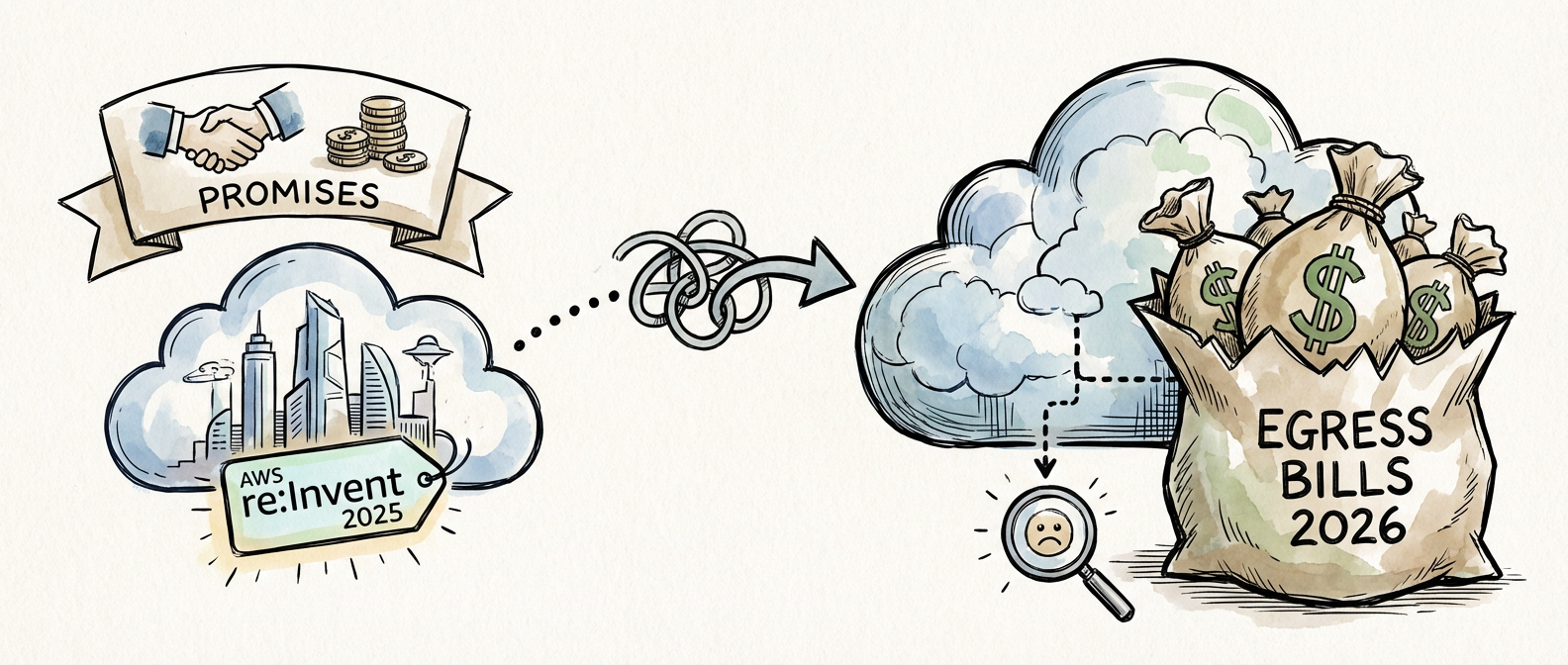
Here’s what I want you to understand before you start updating your spreadsheets: vendor announcements about pricing are theater. Effective theater, sure, but theater nonetheless. The reductions are real. The partnerships are real. But they solve a very specific problem for a very specific subset of customers, and they do not solve the problem most of us actually face.

What the Bandwidth Alliance Actually Covers (And What It Doesn’t)
Let me be direct about Cloudflare’s 2025 Bandwidth Alliance data because I’ve spent enough hours staring at egress charges to have opinions. Enterprises moving data between major cloud providers outside of these formal agreements are still looking at $0.08 to $0.09 per gigabyte for high-volume transfers. That doesn’t sound like much until you do the math on your actual workloads. A modest 100 TB month-long replication operation? That’s between $8,000 and $9,000. Suddenly the Terraform code you wrote to be “cloud-agnostic” starts looking real expensive.
The zero-egress agreements that AWS and Google announced do exist and do work, but here’s the catch: they require you to be using specific CDN partners with specific architectural patterns in specific regions. It’s not zero-egress in general. It’s zero-egress if you conform to what they’ve decided is acceptable. For some teams, that’s a perfect fit. For the rest of us running hybrid workloads across regions and providers, it’s like being told the free parking is available if you’re willing to park exactly where they say.
The Governance Gap That Keeps Engineers Awake
Here’s where things get uncomfortable, and I’m going to say this as someone who genuinely respects both cloud architects and finance teams even when they drive each other to drink: the tools don’t exist yet to actually manage multi-cloud costs with any real sophistication. According to the Flexera 2026 State of the Cloud Report, 89% of enterprises claim to have a multi-cloud strategy. That same report also found that only 28% have mature cost governance tools in place across all their providers. That’s not a typo. That’s an eight-to-one gap between ambition and capability.
Gartner’s 2025 Cloud Cost Optimization report landed a number that should make any CTO’s eyes water: 35% of enterprise cloud spend is being wasted. The egress fees aren’t even the biggest culprit anymore. Multi-cloud networking costs are growing as a share of that waste, but they’re competing with overprovisioned instances, orphaned storage, unused reserved capacity, and the thousand small mistakes that compound across multiple providers with multiple billing systems and multiple rate cards.
The cost governance tools you’re looking at right now probably work beautifully for single-cloud environments, or for giving you dashboards that make you feel informed while you’re actually just getting very good at reading fiction. Real multi-cloud cost tracking requires visibility into inter-cloud networking, requires understanding the actual data flows in your architecture, requires knowing what you’re optimizing for. Most organizations don’t have that visibility. They have billing alerts.
Google’s Cross-Cloud Network and the Maturity Illusion
Google Cloud’s Cross-Cloud Network announced at Google Cloud Next 2025 deserves a separate moment because it represents both genuine progress and the exact kind of vendor limitation that keeps multi-cloud from actually working. The product is architecturally sound. The promise of simplified inter-cloud connectivity is real. But it comes with a critical constraint: workloads have to run on supported regions. In practice, this means you’re trading one form of lock-in for another. You’re no longer locked into a single cloud provider, but you are now locked into specific geographic deployment patterns that Google has decided to support.
This is what happens when vendors get serious about multi-cloud adoption: they solve the problem in a way that benefits their own position. Google gets to host your control plane. Google gets to see your traffic patterns. Google builds the network backbone you depend on. It’s not sinister, but it’s also not the vendor-agnostic nirvana that the marketing copy suggests.
What This Means for Your 2026 Planning
If you’re sitting in a planning meeting right now trying to decide whether to standardize on one cloud or to embrace the multi-cloud future, here’s what I’d tell you: the technology for multi-cloud is getting better, but the economics are getting worse for most organizations. The vendors have gotten smarter about competing without actually competing on the things that matter most to you.
Your data transfer costs aren’t going away. Your governance gaps aren’t going away. The complexity of managing workloads across three different billing systems, three different networking models, and three different optimization strategies isn’t being solved by better pricing for certain edge cases. You want to know what actually helps? Rigorous architecture review. Understanding your data flows before you commit to a topology. Building cost observability into your deployment pipeline the same way you’ve already built security. Choosing your multi-cloud approach based on workload requirements, not based on conference announcements.
The AWS pricing reductions are real wins for the companies that can use them. Google’s network improvements are genuine technical progress. But they’re not solving the fundamental problem: most enterprises haven’t developed the organizational capability to actually manage multi-cloud well. They’ve developed the organizational will to try it. There’s a meaningful difference.
I’m curious what you’re seeing in your own environments. Are the vendor pricing moves actually shifting your decision-making, or are you finding that the hidden costs of multi-cloud coordination are bigger than the sticker price differences? Have you found cost governance tools that actually work across multiple providers, or are you rolling your own? The real intelligence here isn’t in the vendor announcements. It’s in what you’ve learned about your own infrastructure through trial and error. Drop those insights in the comments if you’re willing to share.